
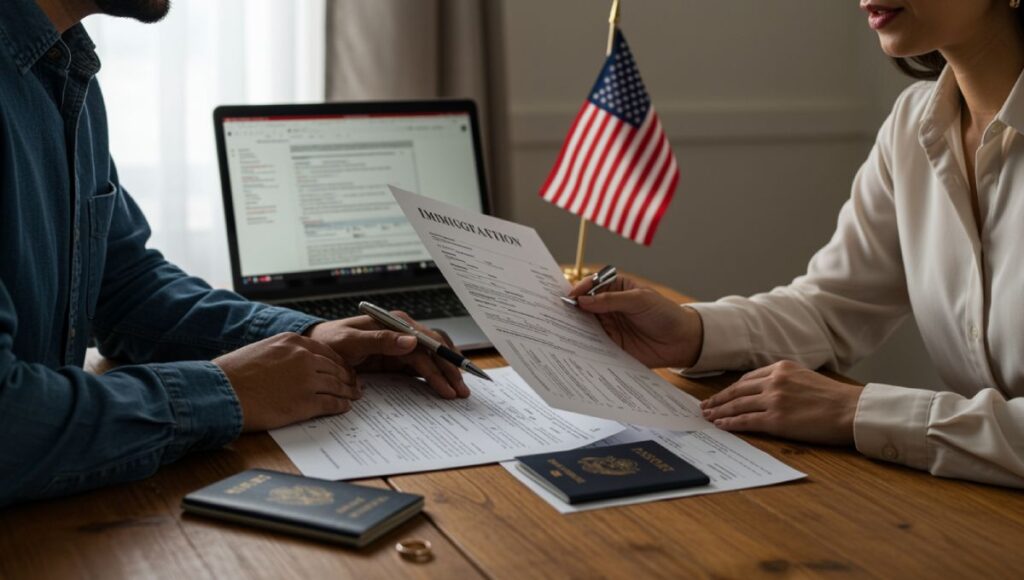
Every US citizen who wants to bring a foreign partner to the United States faces the same fork in the road. You can either bring them here first and marry them after they arrive, or marry them first and bring them here as a spouse.
The first option is the K1 fiance visa. The second is a marriage based immigrant visa, usually the CR-1 (if married less than two years) or the IR-1 (if married two years or more at the time of visa issuance).
Both paths lead to the same destination: your partner living permanently in the United States as your legal spouse. But the timelines, costs, legal steps, and day-to-day experience along the way are meaningfully different.
This guide gives you an honest comparison so you can have an informed conversation with your immigration attorney about which path fits your situation.
The K1 Fiance Visa Path
The K1 visa is designed for couples who have not yet married. The US citizen sponsor files a petition (Form I-129F), and once approved, the foreign fiance attends a consular interview, receives the visa, travels to the US, and the couple must marry within 90 days.
How It Works
- US citizen files I-129F petition with USCIS
- After approval, the case is forwarded to the US embassy in the fiance’s country
- Fiance attends a consular interview and receives the K1 visa
- Fiance enters the US and the couple has 90 days to marry
- After marriage, the spouse files for adjustment of status (Form I-485) to get a green card
K1 Timeline
The total process from filing to your fiance arriving in the US typically takes 12 to 18 months in 2026. After arrival, the 90 day marriage deadline applies, and adjustment of status can take an additional 8 to 14 months.
K1 Costs
Typical total costs range from $2,500 to $5,000 including filing fees, medical exams, document preparation, and adjustment of status fees after marriage. Legal representation adds to this.
The CR-1/IR-1 Marriage Based Visa Path
The marriage based visa is for couples who are already legally married. The US citizen spouse files an immigrant visa petition (Form I-130), and after processing, the foreign spouse attends a consular interview and enters the US as a permanent resident from day one.
How It Works
- The couple gets legally married first, either in person abroad, in the US, or through a remote online ceremony
- US citizen files I-130 petition with USCIS
- After approval, the case goes through the National Visa Center and then to the US embassy
- Foreign spouse attends a consular interview and receives the immigrant visa
- Foreign spouse enters the US with permanent resident status already in hand
CR-1/IR-1 Timeline
The total process from filing to your spouse arriving in the US typically takes 12 to 24 months in 2026. However, your spouse arrives as a permanent resident and does not need to go through a separate adjustment of status process after arrival.
CR-1/IR-1 Costs
Typical total costs range from $1,500 to $3,500 including filing fees, medical exams, and document preparation. Because there is no separate adjustment of status filing, total costs are often lower than the K1 path.
K1 vs. CR-1/IR-1: The Key Differences
When You Marry
K1: you marry after your fiance arrives in the US, within 90 days. CR-1/IR-1: you marry before filing the petition, and your spouse enters as someone who is already legally married to you.
Status on Arrival
This is one of the biggest practical differences. A K1 fiance enters the US as a nonimmigrant with temporary status and cannot work until they file for and receive an Employment Authorization Document. A CR-1/IR-1 spouse enters as a lawful permanent resident from day one, with the right to live and work in the US immediately.
Total Timeline
The K1 petition itself is often processed faster than the I-130, so K1 couples may be reunited sooner. However, the K1 path requires a separate adjustment of status process after marriage, which adds months. When you compare total time from filing to full permanent resident status, the two paths often end up roughly similar.
Total Cost
The CR-1/IR-1 path is generally less expensive overall because it eliminates the adjustment of status filing fee ($1,225 for Form I-485). The K1 path front-loads the reunion but costs more in total.
Flexibility
The K1 visa locks you into a 90 day marriage deadline with no extensions. The CR-1/IR-1 path has no such deadline because the marriage is already done before the visa process begins.
How Online Marriage Changes This Decision
Traditionally, the CR-1/IR-1 path required couples to marry in person, meaning one partner had to travel internationally for the wedding before the visa process could start. That travel cost, logistical complexity, and time commitment made the K1 path more appealing for many couples.
Online marriage through MarriedLegally changes that calculation. Because the ceremony happens over Zoom, couples can get legally married without either partner traveling. The US citizen stays home. The foreign partner joins from their country. A certified marriage certificate is issued and can be used to file the I-130 petition immediately.
This does not automatically make the CR-1/IR-1 path the right choice for every couple. But it removes the biggest logistical barrier that used to tilt the decision toward K1.
Important: which path is right for your specific situation depends on your immigration history, your timeline, your financial situation, and factors that go beyond what this comparison can cover. We strongly recommend discussing both options with an immigration attorney before committing to either one.
Frequently Asked Questions
Can we switch from a K1 to a marriage visa mid-process?
Not easily. If you have already filed the I-129F (K1 petition), getting married before your fiance’s K1 interview invalidates the K1 visa. You would need to withdraw the K1 petition and file an I-130 instead, essentially restarting with a different process.
Which is faster if we just want to be together as soon as possible?
The K1 petition is often approved faster than the I-130, so couples may be physically reunited sooner with the K1 path. However, the K1 fiance cannot work immediately upon arrival, while the CR-1/IR-1 spouse can. Total time to full permanent resident status is often comparable.
Will USCIS accept an online marriage for the CR-1/IR-1 path?
Yes. A certified marriage certificate from MarriedLegally is an official US government document that meets USCIS requirements for all immigration filings, including the I-130 petition.
What if my partner cannot get a tourist visa to come marry me in the US?
This is actually one of the strongest reasons to consider online marriage. If your partner cannot obtain a visitor visa to marry in the US, and traveling to their country is not practical for you, a remote online ceremony allows you to marry without either partner traveling.
Should we hire an immigration attorney to help us decide?
Yes. This is one of the most consequential decisions in the immigration process, and the right answer depends on details specific to your case. An experienced immigration attorney can evaluate both paths against your individual circumstances.
Ready to Marry First? We Make It Simple.
If you and your attorney decide the marriage based visa is the right path, MarriedLegally can get you legally married quickly through a remote Zoom ceremony, with a certified marriage certificate ready for your I-130 filing.
Get In Touch Today:
- Call or text: (435) 764-7933
- Email: info@marriedlegally.com
- Book a consultation: Schedule Now
- WhatsApp / Messenger: available 24/7
- Packages from: $249 all inclusive
- USCIS accepted certificate: for I-130 and all immigration filings
Contact us today and take the first step on whichever path is right for you.
Related Services:
- Online Marriage Services
- Marriage Certificate for Immigration and Green Card Cases
- K1 Fiance Visa Explained: 2026 Guide
- K1 Visa 90 Day Marriage Deadline
- Getting Married Fast (48 Hours)
Serving International Couples Nationwide:
We work with US citizens and their international partners in every state, including New York, Los Angeles, Chicago, Houston, Miami, San Francisco, Seattle, Dallas, Phoenix, Boston, Atlanta, Denver, and Washington DC. The ceremony is fully remote, so your partner can join from anywhere in the world.