
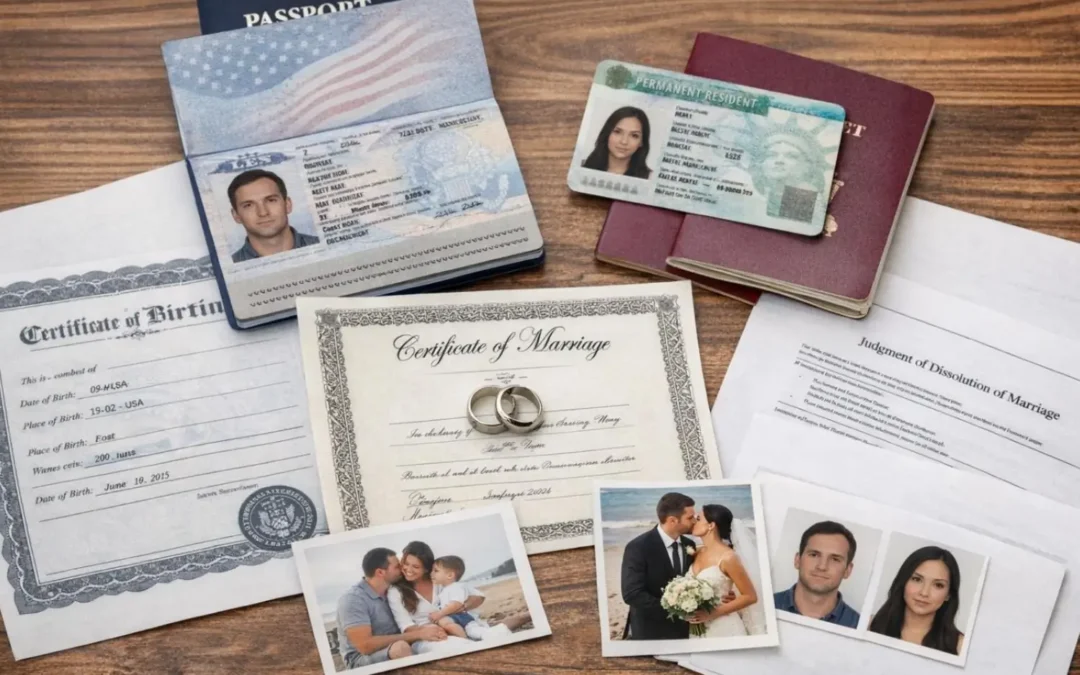
Form I-130 is the petition that proves your marriage is real and qualifies your spouse for a green card. A US citizen or green card holder files it with USCIS, along with Form I-130A, your marriage certificate, and evidence the relationship is genuine. Approval is the first step, not the last.
What Form I-130 Does and Does Not Do
Form I-130, the Petition for Alien Relative, does one job. It asks USCIS to recognize that a qualifying family relationship exists between you and your spouse. That is the whole purpose of the form.
It is worth being blunt about what it does not do, because this is where couples lose months. An approved I-130 does not give your spouse a green card. It does not give them permission to enter the United States, or to work, or to stay if they are already here. It does not shorten any line. What it does is unlock the next stage, which is either an application to adjust status inside the country or an immigrant visa application through a consulate abroad.
Think of it as establishing your standing to ask. Everything that actually gets your spouse a card happens after this petition is approved.
Who Can File, and Who Cannot
Only a US citizen or a lawful permanent resident can file an I-130 for a spouse. The two are treated very differently, and the difference is the single biggest factor in how long you will wait.
US Citizen Petitioners
If you are a US citizen, your spouse is an immediate relative. Immediate relatives are exempt from the annual visa caps that Congress sets for family immigration, which means that once the petition is approved, a visa number is available right away. There is no separate queue to join afterward.
That exemption is the reason a citizen’s spouse case moves in a fundamentally different way than almost every other family petition.
Green Card Holder Petitioners and the Wait That Comes With It
If you are a green card holder, your spouse falls into the F2A preference category. F2A is capped. After USCIS approves the petition, your spouse joins a line governed by the monthly Visa Bulletin published by the State Department, and they cannot move forward until their priority date becomes current.
There is one thing worth knowing here. If you naturalize while the petition is pending or waiting in line, you can upgrade the case to the immediate relative category and skip the visa bulletin wait entirely. For couples close to eligibility for citizenship, that timing decision is worth talking through with an attorney before you file anything.
Before You File: Documents You Need in Hand
Gather everything before you start filling out forms. Petitions get rejected or delayed far more often for missing documents than for wrong answers.
You will need proof of your own status, which means a US passport, birth certificate, naturalization certificate, or green card, depending on which applies. You will need your marriage certificate, issued by the government authority that recorded the marriage. You will need proof that every prior marriage on either side legally ended, which means divorce decrees, annulment orders, or death certificates.
You will need passport style photographs for both of you, and you will need evidence that the marriage is genuine, which is substantial enough that it gets its own section below.
If any document is in a language other than English, it needs a full English translation with a signed certification from the translator confirming the translation is complete and accurate and that they are competent to translate. This trips people up constantly. A translation without that certification statement is not a valid translation for USCIS purposes.
Filling Out Form I-130, Section by Section
Download the current edition of the form directly from the USCIS website on the day you fill it out, not a copy saved months ago. USCIS rejects outdated editions.
Work through it slowly. Answer every question, and where a question does not apply, write N/A rather than leaving it blank. Blank fields read as oversights and can trigger a request for evidence.
The Parts People Get Wrong
A few sections cause most of the trouble.
Addresses. USCIS wants a complete address history, and the dates need to line up without gaps. Approximate months are acceptable, unexplained holes are not.
Names. Every name variation matters, including maiden names, names on prior passports, and names spelled differently across documents. If your spouse’s birth certificate and passport spell their name differently, disclose both. An inconsistency you volunteer is a clerical matter. The same inconsistency found by an officer is a credibility question.
Prior petitions. If you have ever filed an immigration petition for anyone, including a former spouse, it has to be disclosed. This is not a box you want to be wrong about.
Employment history and the beneficiary’s immigration history also need care, particularly any prior visa refusals or removal proceedings.
Form I-130A and Who Has to Complete It
Form I-130A, Supplemental Information for Spouse Beneficiary, is filed alongside the I-130 in spouse cases. It collects the beneficiary’s address and employment history. There is no separate fee for it, and it cannot be filed on its own.
If your spouse is outside the United States, they still complete it, but the signature requirement differs from the version filed by a spouse who is here. Check the current form instructions on this point rather than assuming, because the instructions have changed before.
Proving the Marriage Is Real
This is the heart of the petition. USCIS is not asking whether you love each other. It is asking whether you entered the marriage to build a life together rather than to obtain an immigration benefit. Those are different questions and the evidence that answers them is documentary.
Primary Evidence
The strongest evidence is the boring kind. Joint financial records. A lease or mortgage with both names. Joint bank account statements showing actual activity over time, not an account opened last month with a single deposit. Insurance policies naming each other. Beneficiary designations on retirement accounts. Birth certificates of children you share. Joint tax returns.
Depth beats variety here. Twelve months of a genuinely shared account tells an officer more than eight different documents dated the same week.
Secondary Evidence When You Do Not Live Together Yet
Plenty of real marriages do not have any of that, because the couple has never lived in the same country. This is normal, and it is not fatal. It does mean you build the record differently.
Photographs across the span of the relationship, in different places, with family members present. Travel records, including boarding passes, passport stamps, and hotel bookings. Communication records, which are more persuasive as a representative sample across years than as a screenshot dump from one week. Money transfer receipts. Affidavits from people who know you both, written in their own words with specific detail rather than a form template.
If you married through a legal online ceremony, keep the certificate, the officiant record, and everything documenting the relationship before and after. whether an online marriage holds up is a question with a specific legal answer, and the evidence you keep matters to it.
Filing Fees and Where to Send It
As of 2026, USCIS charges 675 dollars to file Form I-130 by mail and 625 dollars to file it online through a myUSCIS account. That pricing has been in place since the April 2024 fee rule, and online filing has consistently been the cheaper of the two.
Verify the amount on the USCIS fee schedule, Form G-1055, the same week you file. Fees change through formal rulemaking and an incorrect payment gets the petition rejected.
Filing online avoids the biggest paper filing hazard, which is lockbox routing. USCIS directs paper petitions to different lockbox facilities depending on your state and on whether you are filing the I-130 alone or together with other forms, and those addresses change. Check the address on the USCIS I-130 page the same week you mail. A petition sent to the wrong lockbox is typically rejected and returned.
Some situations still require paper filing. Check the current instructions rather than assuming your case can be filed online.
What Happens After You File
USCIS sends a receipt notice, Form I-797C, usually within a few weeks. Keep it. The receipt number on it is how you track the case, and you will be asked for it repeatedly.
From there, the case sits with USCIS while an officer reviews it. Three things can happen. The petition is approved. The officer issues a request for evidence asking for something specific. Or the petition is denied.
One change worth knowing about. In August 2026, USCIS issued a policy alert allowing officers to deny a filing outright, without first issuing a request for evidence, when the initial evidence is missing or does not establish eligibility. It applies to cases already pending. In practice this means the old safety net of filing a thin petition and waiting to be asked for more is gone. Confirm the current status of that policy before you file, and assume your first submission is the one that counts. the new policy on denials without an RFE
Current Processing Times and What Slows a Case Down
Be careful with any specific number you read on this, including numbers on law firm websites. Published estimates for spouse of a US citizen petitions currently range from roughly ten months to well over eighteen, depending on the source, the service center, and whether the case is filed concurrently with an adjustment application. The honest answer is that the range is wide and it moves.
Check the USCIS processing times tool for your specific form, category, and office. That is the only figure that reflects your actual case.
What reliably makes it longer is within your control. Requests for evidence pause the case entirely until you respond. Missing translations, unexplained gaps in a history, name inconsistencies, and thin relationship evidence are the usual triggers. There is no premium processing for the I-130, so you cannot pay to fix a delay after the fact. Accuracy at filing is the only lever you have.
Concurrent Filing vs Consular Processing
Where your spouse is right now determines the path.
If your spouse is already in the United States, entered lawfully, and is otherwise eligible, you may be able to file the I-130 and the Form I-485 adjustment of status application at the same time. Concurrent filing generally shortens the total timeline because USCIS works both together, and it can make work authorization and travel permission available sooner.
Two cautions. Concurrent filing eligibility depends heavily on how your spouse entered the country and what their status has been since. A 2026 USCIS memorandum also directs officers to treat adjustment of status as discretionary relief rather than an entitlement, which raises the stakes on a well documented application. If your spouse’s entry or status history is complicated in any way, get advice before filing rather than after.
If your spouse is abroad, the case goes the consular route. After approval, USCIS transfers it to the National Visa Center, where you pay fees, file the DS-260 immigrant visa application, and upload civil documents before an interview is scheduled. what the NVC stage involves.
I-130 vs I-129F: Which One You Should Be Filing
These are not interchangeable and couples file the wrong one regularly.
Form I-129F is the fiancé petition. It is for a US citizen and a partner they are not yet married to, and it leads to a K-1 visa and a marriage inside the United States within ninety days of arrival. Only US citizens can file it.
Form I-130 is the spousal petition. It is for couples who are already married, and it leads either to adjustment of status here or to a CR-1 or IR-1 immigrant visa abroad.
The decision is not simply about which is faster. They differ in cost, in when work authorization becomes available, in whether the spouse arrives with permanent residence or has to apply for it afterward, and in what happens to any children involved. how the K-1 and CR-1 paths compare walks through that comparison in detail. family based immigration explained covers the wider picture if you are still orienting yourself.
Frequently Asked Questions
How long does an I-130 take for a spouse?
Published ranges vary widely and change often. Check the USCIS processing times tool for your form, category, and office rather than relying on a figure from any article, including this one.
How much does it cost to file Form I-130?
As of 2026, 625 dollars online and 675 dollars by mail. Confirm on the USCIS fee schedule before you pay, since fees change.
Can I speed up my I-130?
There is no premium processing for this form. Expedite requests exist but are granted only in narrow circumstances such as documented humanitarian emergencies. Filing a complete, accurate petition is the practical way to avoid delay.
Does my spouse need Form I-130A?
In spouse cases, yes. It is filed with the I-130 and carries no separate fee.
Can I file if we got married online?
A legally valid marriage can support an I-130. Whether a particular online marriage is recognized for immigration purposes depends on specific legal rules, and it is worth understanding them before you file.
What happens if the petition is denied?
You may be able to appeal, file a motion to reopen or reconsider, or file a new petition. Which route makes sense depends entirely on why it was denied and on the deadline printed on the notice.
Get Your Petition Reviewed Before You Send It
Most I-130 problems are not legal problems. They are documentation problems, and they are almost entirely preventable. A petition reviewed before it goes out costs a fraction of what it costs to respond to a request for evidence or to refile after a denial.
If you are unsure about your spouse’s entry or status history, about a prior marriage or a prior petition, or about which form you should be filing at all, that is worth a conversation before you send anything. get help preparing your filing.