
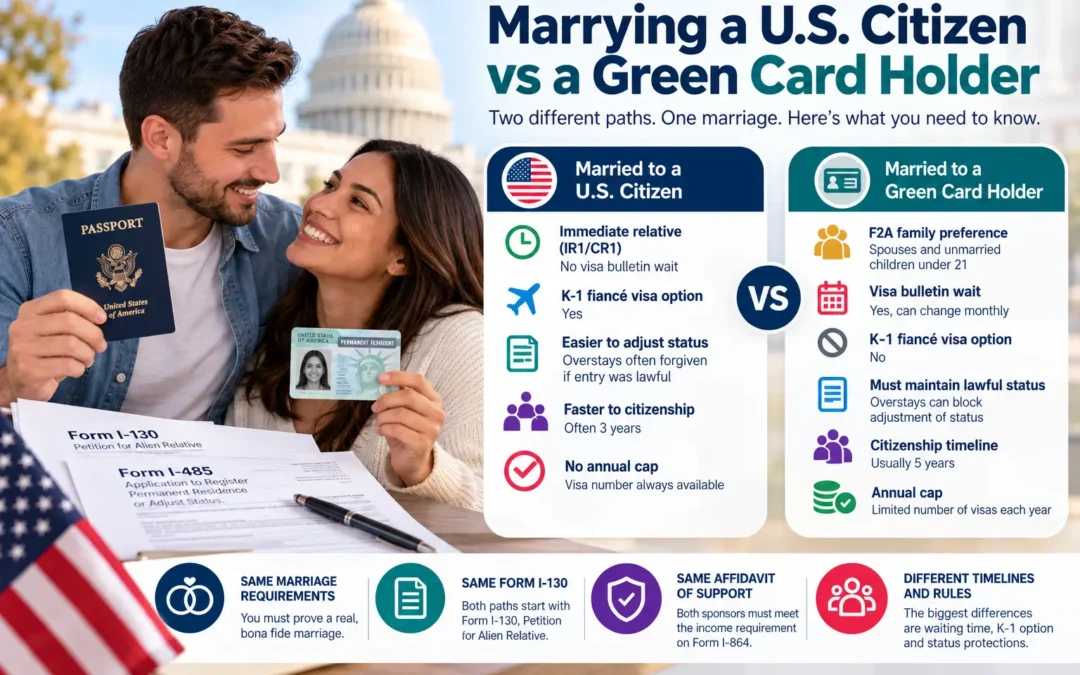
Marrying a green card holder places your spouse in the F2A family preference category, which has an annual cap and follows the visa bulletin. Marrying a U.S. citizen makes your spouse an immediate relative, with no cap and no bulletin wait. The citizen path also offers K-1 fiancé visas and broader protections for spouses already in the U.S.
Many couples only discover this difference after the wedding. The love is the same, the marriage certificate is the same, and yet the immigration process can look completely different depending on one fact: whether the sponsoring partner is a permanent resident or a citizen. Knowing which path you are on helps you plan your timeline, your finances, and your next step.
Two Categories, One Marriage
U.S. immigration law sorts family green cards into two groups. Immediate relatives of U.S. citizens, which include spouses, are not limited by annual quotas. Family preference categories are limited, and F2A covers spouses and unmarried children under 21 of lawful permanent residents.
Both paths start with the same form. The sponsoring spouse files Form I-130, Petition for Alien Relative, with USCIS. After that, the routes split. Our overview of family-based immigration explains how the categories fit together.
Side-by-Side Comparison
| Question | Married to a U.S. Citizen | Married to a Green Card Holder |
|---|---|---|
| Visa category | IR1 or CR1 (immediate relative) | F2A (family preference) |
| Annual cap? | No | Yes |
| Visa bulletin wait? | No | Yes, can change monthly |
| Fiancé visa option? | Yes, K-1 | No |
| Overstay forgiven for adjustment? | Often, if entry was lawful | Generally no |
| Affidavit of support? | Yes, Form I-864 | Yes, Form I-864 |
| Conditional green card if married under 2 years? | Yes | Yes |
| Spouse’s citizenship timeline | Often 3 years | Usually 5 years |
Marrying a U.S. Citizen: The Faster Lane
Spouses of citizens move without waiting for a visa number. Once USCIS approves the I-130, the case goes straight to the National Visa Center and then an embassy interview, or the spouse in the U.S. can file for adjustment of status, often at the same time as the I-130.
The U.S. Department of State explains the consular route on its spouse and fiancé visa page. Couples who are engaged but not married can also choose the K-1 fiancé visa. Our guide to K-1 vs CR-1 and IR-1 visas walks through that choice in detail.
Protection for Spouses Already in the U.S.
Immediate relatives who entered the country lawfully can often adjust status even if they later overstayed. This is one of the most important advantages of the citizen path, and it is a key reason couples should get advice before assuming they must leave the country.
Marrying a Green Card Holder: The Preference Path
F2A spouses wait for their priority date to become current in the monthly visa bulletin. In some years that wait has been several years. In others, including October 2026, F2A has been very close to current. You can follow the latest movement in our F2A visa bulletin update.
No K-1 Option
Permanent residents cannot file a fiancé visa. The couple must be legally married before the I-130 is filed. If you are engaged to someone abroad and travel is difficult, this is where many couples get stuck.
Some couples ask whether the foreign partner can simply visit on a tourist visa and marry in the U.S. That is very risky. Entering on a visitor visa with a hidden plan to stay can be treated as misrepresentation, and an F2A spouse who marries during a visit generally cannot stay and adjust status anyway. Plan the marriage carefully, ideally with legal advice, and then file the petition properly.
Less Room for Status Problems
An F2A spouse in the U.S. generally needs to have kept lawful status the whole time to adjust status here. Overstays, status gaps, or unauthorized work can block adjustment and force consular processing abroad, which can carry its own risks. This is the clearest area where professional advice protects your case.
What Both Paths Have in Common
Proving a Real Marriage
USCIS wants evidence that your marriage is genuine, not just legal. Joint finances, shared addresses, photos over time, travel records, and communication history all help. The bona fide marriage standard is identical for both categories, so whichever path you take, start organizing evidence early.
The Affidavit of Support
Every sponsor, citizen or permanent resident, must show income at or above 125 percent of the federal poverty guidelines on Form I-864, or use a joint sponsor. Our post on sponsor income requirements explains how to qualify, and the new Form I-864 edition post covers the latest form change.
Conditional Residence
If the marriage is less than two years old when the green card is approved, your spouse receives a two-year conditional card. Near the end of that period you file jointly to remove conditions, which we explain in our I-751 process guide.
When the Green Card Holder Becomes a Citizen
Here is the good news for F2A couples: the category is not permanent. If the permanent resident naturalizes, the spouse automatically becomes an immediate relative. A pending petition generally converts without starting over, and the visa bulletin stops applying.
Citizenship also shortens the foreign spouse’s own road. Under the USCIS Policy Manual, a permanent resident married to and living with a U.S. citizen can usually apply for naturalization after three years instead of five, if the citizen spouse has held citizenship for that whole period.
[CLIENT INPUT NEEDED: one real, anonymized observation from the Married Legally team, for example couples who did not realize the sponsor’s status changed their options.]
Getting Married When You Cannot Be in the Same Place
For both paths, the marriage must be legally valid. For F2A couples, marriage is the only door in, since there is no fiancé visa. When visa refusals, cost, or distance keep you apart, a legal online marriage for immigration lets you marry under a Utah license from two different countries. Our marriage certificate green card guide shows how that certificate is used in the I-130 filing.
How to Choose Your Next Step
- Confirm the sponsoring spouse’s status: citizen or permanent resident.
- If a permanent resident, check citizenship eligibility and timing.
- Confirm where the foreign spouse lives and their full immigration history.
- If not yet married, decide between a K-1 (citizens only) or marrying first.
- File the I-130 with strong relationship evidence.
- Prepare the affidavit of support on the current form edition.
What This Means for You
If your partner is a U.S. citizen, your spouse skips the visa queue and has more options, including the K-1. If your partner is a green card holder, expect the visa bulletin, stricter rules for status problems, and no fiancé visa. Naturalization can switch you to the faster lane, so check eligibility early.
Not sure which path fits your situation? Our immigration services include attorney oversight from start to finish. Book a free consultation and we will map out your options together.
Frequently Asked Questions
Can a green card holder sponsor a spouse?
Yes. A lawful permanent resident can file Form I-130 for a spouse in the F2A category. The spouse must wait until their priority date is current in the visa bulletin before a green card can be issued. The sponsor must also file an affidavit of support and live in the United States.
Is it faster to marry a U.S. citizen or a green card holder?
Marrying a U.S. citizen is usually faster, because spouses of citizens are immediate relatives with no annual cap. F2A spouses depend on the visa bulletin, which can move forward or backward. When F2A is current, the gap narrows, but processing rules for spouses inside the U.S. still differ.
Can a green card holder bring a fiancé to the U.S.?
No. The K-1 fiancé visa is only available to U.S. citizens. A permanent resident must legally marry their partner first and then file an I-130. Couples who cannot travel to each other often choose a legal online marriage so the petition can be filed sooner.
What happens to my spouse’s case if I become a citizen?
Your spouse’s case is generally upgraded from F2A to the immediate relative category once you naturalize. The visa bulletin no longer applies, which can save significant time. Let USCIS or the National Visa Center know about your naturalization so the case is updated to the correct category.
Does my spouse get a conditional green card either way?
Yes. If you have been married for less than two years when the green card is approved, your spouse receives a two-year conditional card, whether you are a citizen or a permanent resident. You then file Form I-751 together to remove the conditions before the card expires.
This article is general information about U.S. immigration procedure. It is not legal advice and it does not create an attorney client relationship. Immigration rules change often. For guidance on your own case, book a free consultation with the Married Legally team or speak with a licensed immigration attorney.