
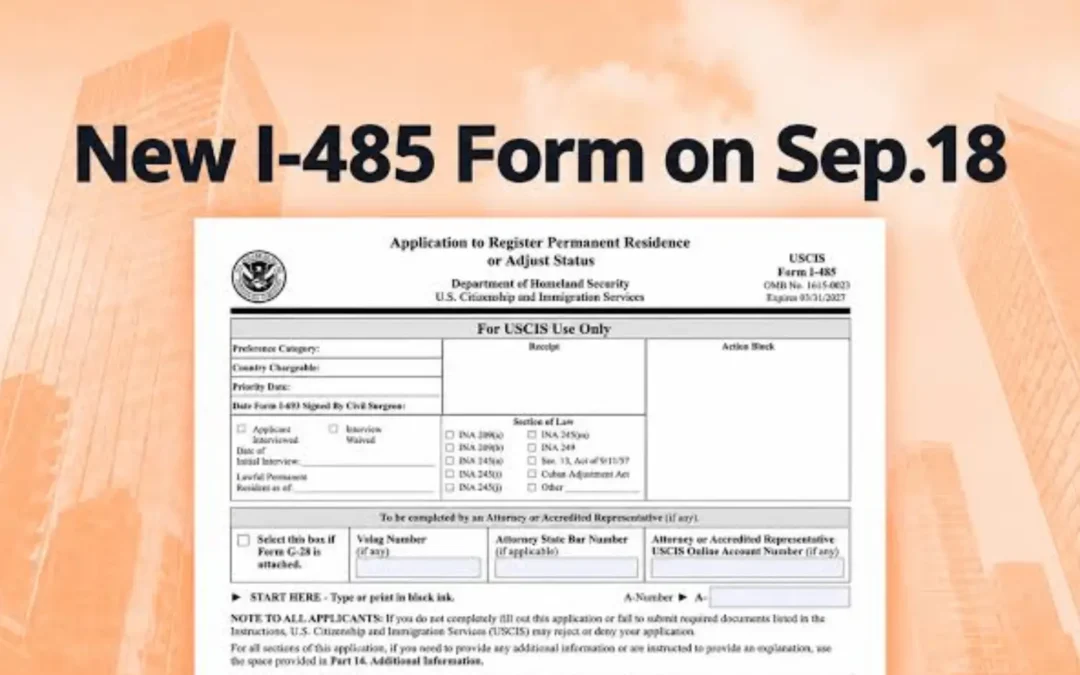
On September 18, 2026, USCIS will begin requiring a new edition of Form I-485, Application to Register Permanent Residence or Adjust Status. There is no grace period. Applications using the old 01/20/25 edition that are postmarked or electronically submitted on or after September 18 will be rejected.
Why USCIS Is Releasing a New Form
The new Form I-485 is directly tied to the Department of Homeland Security’s new public charge rule, which also takes effect on September 18, 2026. Because the new rule changes how USCIS evaluates whether an applicant might become a public charge, the form needed to be updated to collect different information.
This is not a routine form refresh. The changes are concentrated in the public charge section, and the revised form aligns with a new adjudication framework that gives officers broader discretion.
Which Edition Do You Use
Filing Before September 18
If your Form I-485 will be postmarked or electronically submitted before September 18, 2026, use the current edition dated 01/20/25. USCIS will continue accepting that edition for filings received before the cutoff.
USCIS has specifically warned applicants not to use the new 09/18/26 edition before September 18. Filing the new form early will also result in rejection.
Filing On or After September 18
If your filing is postmarked or submitted on or after September 18, 2026, you must use the new 09/18/26 edition. Check the edition date on every page of your printed form before mailing it. The date appears in the bottom left corner of each page.
If you are filing electronically, verify that the USCIS website is serving the correct edition on the day you submit.
There Is No Grace Period
Unlike many form transitions, USCIS has stated there is no grace period for the old edition. This is worth repeating because it is the part that catches people.
A rejected application is not a denial. It means USCIS never accepted the filing. You do not receive a filing date, you do not receive a receipt number, and any fees submitted may be returned without being processed. If you were relying on a specific filing date for priority date purposes, a rejection forces you to start over.
For couples adjusting status after marriage, losing that filing date can mean weeks or months of delay, and it can affect eligibility for a work permit and travel document in the interim.
What Changed on the Form
The Public Charge Section
Most of Form I-485 is unchanged. The meaningful edits are concentrated in the public charge section, where applicants disclose whether they have received certain government benefits.
Under the new form, applicants may be asked to provide more detail about benefit receipt. The form aligns with the new totality of circumstances standard, which gives officers discretion to weigh a broader range of factors when assessing whether an applicant is likely to become a public charge. See the public charge rule change explained for how that standard works.
What Was Removed From the Instructions
The old form instructions contained detailed guidance about which benefits counted and how they were weighed. Much of that has been stripped from the new instructions. USCIS is directing applicants to its online public charge resources instead.
In practical terms, this means the form itself gives you less help filling it out correctly. Review the USCIS public charge policy guidance before completing the public charge section, and consider having an attorney review that section before filing.
What About Forms I-765 and I-864
Two other forms tied to the adjustment process also have new editions this fall. Form I-765, Application for Employment Authorization, moved to a new edition on September 15, 2026. Form I-864, Affidavit of Support, moved to a new edition (08/24/26) on August 31, 2026, and now includes a credit report authorization.
If you are filing a concurrent package (I-130, I-485, I-765, I-864), make sure every form in the packet is the current edition as of your filing date. One outdated form can cause the entire package to be rejected or returned.
How This Affects K-1 and Marriage Green Card Filers
If you married on a K-1 visa and are adjusting status, the new form applies to you. If you married abroad or through an online ceremony and are filing a spousal petition with concurrent adjustment, the new form applies to you. If you are filing the I-485 for any marriage-based green card, the edition you use depends entirely on your filing date.
This is not limited to new marriages. Couples who have been married for years and are just now filing for adjustment are also affected.
See what happens after the K-1 wedding for the full adjustment process, and adjustment of status step by step for how the I-485 fits into the larger filing.
Filing Near the Deadline: Practical Steps
If your filing date will be close to September 18, take extra care. Double-check the edition date on every page of every form in your packet. Print fresh copies from the USCIS website on the day you assemble the package. Do not rely on forms you downloaded weeks ago.
If mailing, use a service that provides a postmark or tracking date. Your postmark is what determines which edition applies, not the date USCIS receives it.
If filing electronically, screenshot the confirmation page with the date stamp.
Frequently Asked Questions
What happens if I accidentally file the old form after September 18? USCIS will reject your application. It will not be treated as a denial, but you will not receive a filing date or receipt number. You will need to refile using the correct edition.
Can I file the new form before September 18? No. USCIS has said it will not accept the 09/18/26 edition before September 18. Filing the new form early will also result in rejection.
Does this affect pending cases? No. If your I-485 was properly filed and accepted before September 18, it remains under the old rules. The new form requirement applies only to new filings.
Where can I download the correct form? Always download Form I-485 directly from uscis.gov/i-485 on the day you plan to file. Do not use forms from third-party websites, cached copies, or forms you printed earlier.
Does the new form cost more? USCIS has not announced a fee change tied to this form update. Check the current fee schedule on the USCIS Form G-1055 page before filing.