
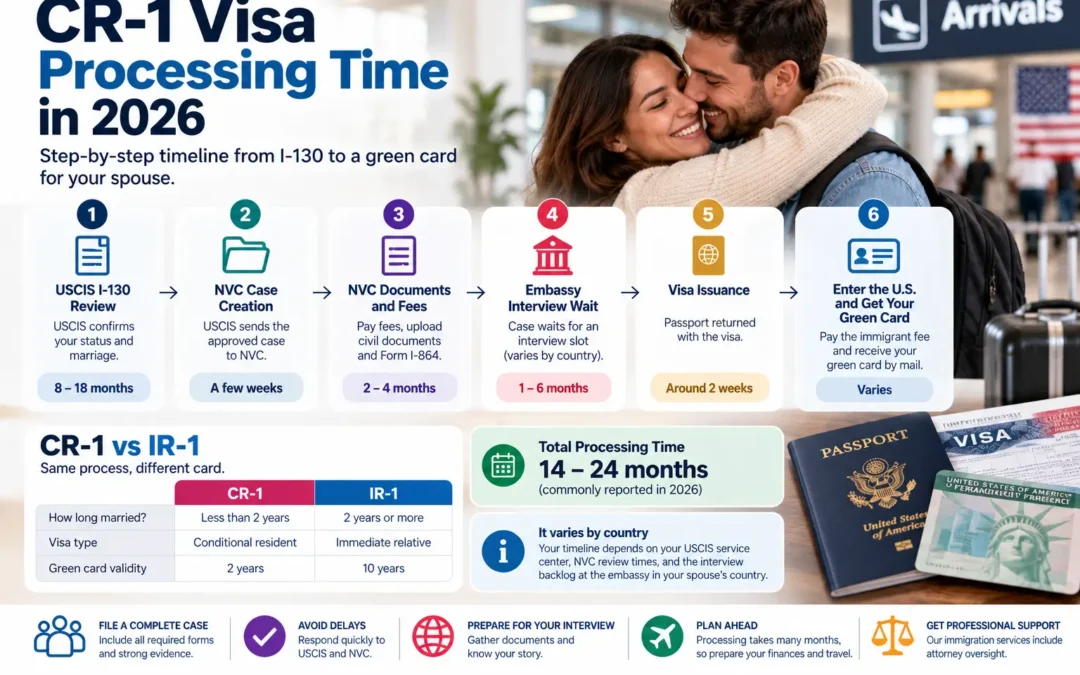
The CR-1 visa processing time in 2026 is commonly reported at roughly 14 to 24 months from filing Form I-130 to visa issuance. The biggest share is USCIS review of the I-130, followed by National Visa Center document processing and the wait for an embassy interview, which varies widely by country.
When you are married and living in different countries, every month apart feels long. The hardest part is often not knowing where you are in the process or what comes next. This guide breaks the CR-1 timeline into stages, so you can see what is normal, what you can speed up, and where to check the official numbers yourself.
CR-1 vs IR-1: Same Process, Different Card
The CR-1 and IR-1 are both immigrant visas for spouses of U.S. citizens. The only difference is how long you have been married when your spouse enters the U.S. Married less than two years means CR-1 and a two-year conditional green card. Married two years or more means IR-1 and a ten-year card.
The processing steps and timeline are the same for both. If you are still choosing between a spousal visa and a fiancé visa, see our comparison of K-1 vs CR-1 and IR-1 visas.
CR-1 Timeline at a Glance
| Stage | What Happens | Commonly Reported Range |
|---|---|---|
| 1. USCIS I-130 review | USCIS confirms your status and marriage | About 8 to 18 months |
| 2. NVC case creation | USCIS sends the approved case to NVC | A few weeks |
| 3. NVC documents and fees | You pay fees, upload civil documents and the I-864 | About 2 to 4 months |
| 4. Embassy interview wait | Case waits for an interview slot | About 1 to 6 months, by country |
| 5. Visa issuance | Passport returned with the visa | Often around 2 weeks |
These ranges come from published estimates and real case reports, not guarantees. Your own timeline depends on your service center, your embassy, and how quickly you respond at each step.
Stage 1: USCIS Reviews the I-130
Everything starts when the U.S. citizen files Form I-130 with USCIS. This is usually the longest stage. USCIS checks the petitioner’s citizenship, the validity of the marriage, and evidence that the relationship is genuine.
A complete, well-organized petition is the best way to avoid an RFE, which can add months. Our step-by-step guide on how to file an I-130 for your spouse covers exactly what to include. Check your own estimate with the USCIS processing times tool by selecting Form I-130 and your service center.
Which Service Center Has Your Case?
Your receipt notice shows a three-letter code at the start of your case number, such as IOE, which tells you where the case is being processed. Processing times can differ sharply between offices, and USCIS sometimes moves cases between them to balance workloads. If your case is transferred, you will receive a notice. A transfer is normal and does not mean anything is wrong, but it can change the estimate you see online.
Stage 2: National Visa Center Case Creation
Once USCIS approves the I-130, it sends the case to the National Visa Center. NVC creates your case and sends a welcome letter or email with your case number and invoice ID. The State Department publishes current progress on its NVC Timeframes page, updated weekly.
Stage 3: Fees, Documents, and the Affidavit of Support
This is the stage you control most. Through the State Department’s Consular Electronic Application Center, you will:
- Pay the immigrant visa fee and the affidavit of support fee.
- Complete the DS-260 online immigrant visa application.
- Upload civil documents, such as passports, birth certificates, police certificates, and the marriage certificate.
- Upload the sponsor’s Form I-864 and financial evidence.
Make sure the sponsor uses the new Form I-864 edition, as outdated forms can be refused. Any document NVC rejects sends you to the back of the review queue, so check every upload carefully. Our post on sponsor income requirements helps you confirm the financial side before you submit.
[CLIENT INPUT NEEDED: one real, anonymized observation from the Married Legally team, for example the NVC document issues that most often add weeks to a case.]
Stage 4: Waiting for the Embassy Interview
When NVC marks your case “documentarily qualified,” it waits for an interview slot at the embassy or consulate in your spouse’s home country. This is where timelines vary the most. Busy posts can take many months, while smaller ones may schedule within weeks.
Country-specific factors matter too. Our pages on Philippines to USA immigration, Mexico to USA immigration, and India to USA immigration cover the local steps couples often miss.
The Medical Exam
Before the interview, your spouse completes a medical exam with an embassy-approved panel physician. Book it as soon as the interview date arrives, since panel physicians can be busy.
Preparing for the Interview
The consular officer will ask about your relationship and review original documents. Many of the same principles in our visa interview preparation guide apply to spousal interviews: bring originals, know your story, and answer honestly.
Stage 5: Visa Issued, Entry, and the Green Card
If approved, the embassy keeps the passport to print the visa, often returning it within about two weeks. Your spouse pays the USCIS immigrant fee and enters the U.S. as a permanent resident. The physical green card arrives by mail afterward. CR-1 holders must later apply to remove conditions, which we cover in our I-751 process guide.
What Can Slow Down Your CR-1 Case
- A Request for Evidence on the I-130.
- Missing or rejected civil documents at NVC.
- An affidavit of support below the income threshold, or no joint sponsor.
- Administrative processing after the interview.
- Interview backlogs at your spouse’s embassy.
- Name or date inconsistencies between documents.
How to Keep Your Case Moving
- File a complete I-130 with strong relationship evidence.
- Respond to NVC within days, not weeks.
- Gather police certificates early, as some countries take months.
- Have the sponsor’s tax and income documents ready before NVC asks.
- Track your case weekly on the official USCIS and State Department tools.
- Get professional review before submitting anything you are unsure about.
Not Married Yet? Start the Clock Sooner
The CR-1 clock cannot start until you are legally married. Couples separated by distance or visa refusals sometimes wait a year or more just to arrange a wedding in the same country. A legal online marriage for immigration lets you marry under a Utah license from two different countries, so you can file your I-130 sooner.
What This Means for You
Plan for a CR-1 process measured in many months, not weeks. Most of the time sits with USCIS and your embassy, but you control the quality of your filing and your speed at NVC. Get those right, track your case on official tools, and you avoid the delays that add the most time.
Want a realistic timeline for your case? Our immigration services include attorney oversight at every stage. Book a free consultation and let us review where your case stands.
Frequently Asked Questions
How long does a CR-1 visa take in 2026?
Most published estimates place the full CR-1 process at roughly 14 to 24 months, from filing the I-130 to visa issuance. Some cases move faster and some take longer, depending on the USCIS service center, NVC review times, and the interview backlog at the embassy in your spouse’s country.
Is the CR-1 faster than the K-1 fiancé visa?
Not always. The K-1 can sometimes reach the U.S. sooner, but it adds a second stage after arrival: the wedding within 90 days and an adjustment of status filing. The CR-1 often takes longer upfront, but your spouse arrives as a permanent resident, ready to work and travel.
Can I speed up my CR-1 case?
There is no premium processing for the I-130 or the immigrant visa. You can request an expedite from USCIS or the embassy in limited cases, such as severe financial loss or urgent medical need. The most reliable way to save time is filing a complete case and responding quickly.
How do I check my NVC case status?
Log in to the Consular Electronic Application Center with your NVC case number and invoice ID. You can also compare your dates with the NVC Timeframes page, which the State Department updates weekly. If your case is outside the posted timeframe, use the NVC Public Inquiry Form to ask.
Can my spouse visit the U.S. while the CR-1 is pending?
It is possible but difficult. A pending immigrant petition shows intent to immigrate, so tourist visa applications are often refused. If your spouse does visit, they must have a valid visa and leave on time. Never plan to adjust status after entering as a tourist without legal advice.
This article is general information about U.S. immigration procedure. It is not legal advice and it does not create an attorney client relationship. Immigration rules change often. For guidance on your own case, book a free consultation with the Married Legally team or speak with a licensed immigration attorney.