
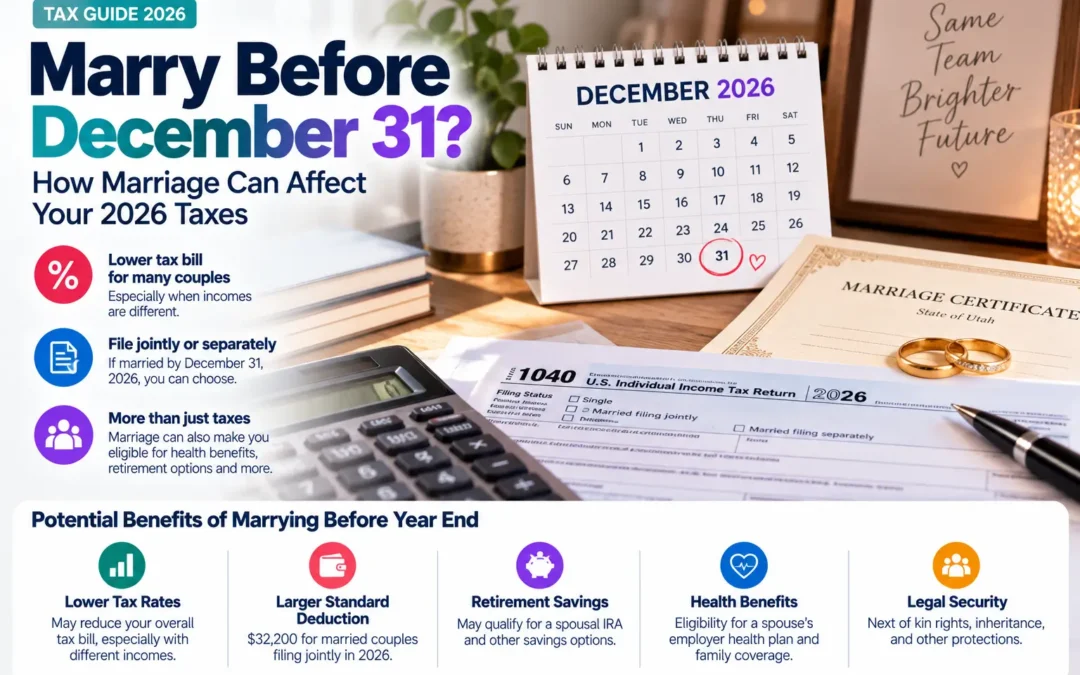
The IRS uses your marital status on December 31 to set your filing status for the entire year. If you marry on or before December 31, 2026, you are treated as married for all of 2026 and can file jointly or separately. For many couples, getting married before the end of the year lowers their tax bill.
You have been talking about getting married “soon” for a while. Then someone mentions taxes, and suddenly the calendar matters. It is true: a wedding on December 31 counts the same as one in January. Whether that helps or hurts depends on your incomes, your credits, and your plans. Here is how it works, so you can make the decision with real information.
The December 31 Rule Explained
According to IRS Publication 501, if you are married on the last day of the tax year, you are considered married for the whole year. It does not matter if your wedding was in March or at 11 p.m. on New Year’s Eve.
That means a couple who marries by December 31, 2026 files their 2026 return as married, either jointly or separately. A couple who marries on January 1, 2027 files 2026 as two single people.
What Counts as Married?
You need a legally valid marriage. Living together does not count, and in most states long-term cohabitation does not create a marriage. Our post on common law marriage myths explains why. It is also the marriage certificate, not just the license, that proves the marriage happened, as our guide to marriage license vs marriage certificate explains.
Who Usually Benefits From Marrying Before Year End
Couples With Very Different Incomes
This is the classic “marriage bonus.” When one partner earns much more than the other, filing jointly often pulls the combined income into lower brackets than the higher earner would face alone. Couples where one partner had little or no income this year often see the biggest savings.
Couples Who Benefit From a Larger Standard Deduction
For tax year 2026, the standard deduction is $32,200 for married couples filing jointly and $16,100 for single filers, according to the IRS inflation adjustments. The joint amount is double the single amount, so the deduction itself is neutral. The real gain comes from how your incomes combine in the brackets.
Couples Planning Retirement Savings
Married couples filing jointly can sometimes use a spousal IRA, letting a non-working or lower-earning spouse contribute based on the other’s income. That can open savings options that were not available before.
Couples Who Want Benefits Sooner
Taxes are not the only year-end reason. Marriage can make a spouse eligible for an employer’s health plan, family coverage, or other workplace benefits, often through a special enrollment window that opens after the wedding. Some couples also want legal status as next of kin before a surgery, a move, or a new job. If any of these apply, marrying in December can solve more than one problem at once. Check your employer’s enrollment deadlines, because many require you to report the marriage within about thirty days.
When Marrying Before Year End May Cost More
The “marriage penalty” is real for some couples. It can show up when:
- Both partners have high, similar incomes that push you into the top brackets together.
- One partner currently qualifies for income-based credits, such as the Earned Income Tax Credit, that phase out with combined income.
- One partner receives premium tax credits for marketplace health insurance, which are recalculated on household income.
- One partner has large medical expenses or other deductions tied to a percentage of income.
- Student loan repayment plans are calculated on household income.
Married filing separately can soften some of these effects, but it also limits several credits and deductions. Always run the numbers, or ask a tax professional, before you decide based on taxes alone.
Quick Comparison
| Your Situation | Likely Tax Effect of Marrying by December 31 |
|---|---|
| One high earner, one low or no earner | Often a tax saving |
| Two similar middle incomes | Often neutral |
| Two high incomes | Possible marriage penalty |
| One partner relies on income-based credits | Possible loss of credits |
| One partner on subsidized marketplace insurance | Credit may change; check carefully |
[CLIENT INPUT NEEDED: one real, anonymized observation from the Married Legally team, for example how many couples book December ceremonies for tax or benefit reasons.]
Marrying Someone From Another Country
If your spouse is a nonresident alien, the rules are different. Generally, you cannot file jointly unless you both choose to treat the nonresident spouse as a U.S. resident for tax purposes, which brings their worldwide income into the U.S. return. The IRS explains the options on its nonresident spouse page. Your spouse will also need a Social Security number or an individual taxpayer identification number.
Binational couples often marry for immigration reasons too. Our page on online marriage for immigration explains how couples in different countries marry legally under a Utah license.
After the Wedding: Your Tax To-Do List
- If either of you changed your name, update it with the Social Security Administration before filing, so your names match IRS records.
- Update your Form W-4 with each employer to reflect your new filing status. The IRS Tax Withholding Estimator can help.
- Update your address with the IRS if you moved.
- Report the marriage to your health insurance marketplace if either of you has marketplace coverage.
- Review beneficiaries on retirement accounts and life insurance.
- Decide whether to file jointly or separately, ideally by comparing both.
How to Get Legally Married Before December 31
Late December is a hard time to plan a wedding. Courthouses close for holidays, officiants are booked, and family travel is expensive. That is why many couples choose a legal online ceremony instead. You can marry under a Utah license from home, wherever you live, and receive an official marriage certificate.
If time is short, see how couples get married in 24 hours, or read our guide to getting married fast. Want to compare costs? Our virtual vs traditional wedding cost comparison breaks it down. If you are also thinking about finances long term, our post on whether you need a prenup is worth reading first.
Do Not Marry Only for Taxes
Taxes are a good reason to pick a date, not a reason to get married. Marriage also changes inheritance, health decisions, benefits, debts, and immigration options. If you are ready to marry anyway, the December 31 rule is simply a helpful nudge on timing.
What This Means for You
If you marry on or before December 31, 2026, the IRS treats you as married for all of 2026. For many couples, especially those with unequal incomes, that means a lower tax bill. Run the numbers or speak to a tax professional, then book your ceremony with enough time to receive your certificate.
Ready to marry before the year ends? Explore our online wedding packages and pick a date that works for you, or contact our team with questions about December availability.
Frequently Asked Questions
If we get married on December 31, are we married for the whole year?
Yes. The IRS uses your marital status on the last day of the year. If you are legally married on December 31, 2026, you are treated as married for all of 2026, and you can choose to file your 2026 return jointly or as married filing separately.
Is it better to file jointly in the first year?
Often, but not always. Filing jointly usually gives access to more credits and lower combined rates, especially when incomes are unequal. Couples with high similar incomes, or one partner relying on income-based credits, may find filing separately or waiting better. Compare both options before you file.
What is the marriage penalty?
The marriage penalty happens when a married couple pays more tax filing jointly than they would have as two single filers. It most often affects couples with two high incomes, or couples where marriage reduces income-based credits. Many couples get a marriage bonus instead, so it depends on your situation.
Does an online marriage count for taxes?
A legally valid marriage counts for federal tax purposes, regardless of whether the ceremony happened online or in person. A properly performed online marriage under a Utah license results in an official marriage certificate. Keep a copy of the certificate with your tax records in case it is ever needed.
Do we need to tell the IRS we got married?
There is no separate marriage notice. You report your new status by choosing a married filing status on your next return. Before that, update any name change with Social Security, adjust your W-4 at work, and update your address with the IRS if you moved.
This article is general information. It is not tax, financial, or legal advice, and it does not create an attorney client relationship. Tax rules and figures change. For advice about your own situation, speak with a qualified tax professional, or contact the Married Legally team with questions about getting married.