**In 2026 the State Department extended its online presence review to K-1 fiancé visa applicants. Consular officers may review publicly available social media to confirm identity, check admissibility, and compare what they see with your petition, visa application, and interview answers. Consistency matters far more than having a perfect profile.**
You have spent months gathering photos, chat logs, and travel records to prove your relationship is real. Now you hear the consulate may also look at your fiancé’s Facebook, Instagram, or TikTok. It is natural to worry. The good news is that for most genuine couples, this review is not something to fear. It is something to prepare for.
What Changed in 2026
Social media questions are not new. Since 2019, U.S. visa applications have asked applicants to list the social media identifiers they have used in the past five years. What changed is the depth of review.
The State Department began a broader “online presence review” with student and exchange visitors in 2025, then expanded it to other categories. According to immigration law firms tracking the change, K-1 fiancé applicants and their K-2 children were added on March 30, 2026. Officers can now look more closely at public content as part of the visa decision.
The basic K-1 rules have not changed. You can review them on the official [State Department K-1 visa page](https://travel.state.gov/content/travel/en/us-visas/immigrate/family-immigration/nonimmigrant-visa-for-a-fiance-k-1.html) and in our guide to [K-1 fiancé visa requirements and timeline](https://marriedlegally.com/k1-fiance-visa-requirements-timeline-2026/).
What Consular Officers Look For
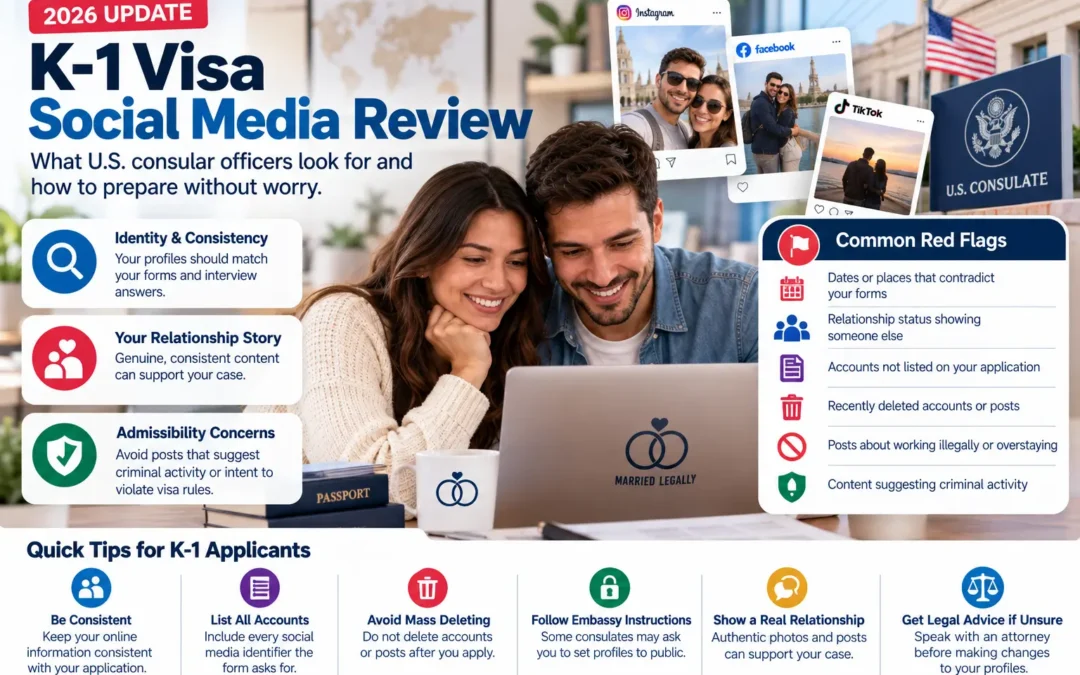
Identity and Consistency
Officers compare your online footprint with your forms. Does the name, birth date, employer, education, and location history match your [DS-160 visa application](https://travel.state.gov/content/travel/en/us-visas/visa-information-resources/forms/ds-160-online-nonimmigrant-visa-application.html)? If your profile says you live in another city or work somewhere you never mentioned, expect questions.
Your Relationship Story
Your public posts can support your relationship or raise doubts about it. Officers may notice if you claim to have met in person in a certain month, but your posts suggest you were somewhere else. They may also notice if a profile still lists you as in a relationship with someone else.
On the positive side, a public history of photos, comments, and messages between you can support your case. Officers see many couples whose online lives show years of genuine connection. You do not need to post more to impress anyone, but there is no reason to hide a real relationship either. Authentic, consistent content is helpful.
Admissibility Concerns
The review is also about security and admissibility. Content suggesting criminal activity, support for violence, or intent to violate visa rules can lead to refusal or further checks. Posts joking about “staying in America forever no matter what” are a bad idea for anyone in the process.
What Can Raise Red Flags
| Online Issue | Why It Matters | What to Do |
|---|---|---|
| Dates or places that contradict your forms | Raises credibility questions | Review your timeline and correct your forms if they are wrong |
| Relationship status showing someone else | Suggests the relationship may not be genuine | Update your status honestly |
| Accounts not listed on the visa application | Can look like concealment | List every identifier the form asks for |
| Recently deleted accounts or posts | Can look like hiding information | Do not mass-delete after applying |
| Posts about working illegally or overstaying | Signals intent to violate visa terms | Talk to an attorney before your interview |
| Content suggesting criminal activity | Can trigger admissibility concerns | Get legal advice immediately |
Should You Delete Posts or Accounts?
This is the most common question, and the answer is usually no. Deleting accounts or scrubbing years of posts after you apply can look like you are hiding something. If an officer notices that an account listed on your application has vanished, that creates exactly the doubt you were trying to avoid.
Leaving out an account on purpose is worse. Willful misrepresentation on a visa application can make someone permanently inadmissible under [INA 212(a)(6)(C)(i)](https://www.law.cornell.edu/uscode/text/8/1182). A forgotten account from ten years ago is rarely a problem if you disclose it honestly. Hiding a current one is a real risk.
If something on your profile truly concerns you, speak with an attorney before changing anything. Our guide on [whether you need an immigration attorney](https://marriedlegally.com/do-you-need-immigration-attorney-k1-visa-green-card/) explains when professional help makes the biggest difference.
Public or Private Profiles?
Reports differ on whether K-1 applicants must set every profile to public, as some other visa categories are told to do. Follow the instructions from your embassy or consulate exactly. If you are asked to make profiles public, do it before your interview and leave them public until the visa is issued.
For some couples, visibility carries real risk. LGBTQ+ couples where one partner lives in a country that does not accept same-sex relationships face a difficult balance between privacy and compliance. Our guide for [same-sex K-1 fiancé couples](https://marriedlegally.com/same-sex-k1-fiance-visa-what-to-know/) covers this, and an attorney can help you handle it safely.
[CLIENT INPUT NEEDED: one real, anonymized observation from the Married Legally team, for example how often couples’ online timelines do not match their forms.]
How to Prepare Before Your K-1 Interview
- List every social media identifier you have used in the past five years on your DS-160.
- Review your profiles together, the way a stranger would see them.
- Check dates, locations, jobs, and schools against your I-129F and DS-160.
- Update outdated relationship statuses honestly.
- Do not delete accounts or large numbers of posts after applying.
- Avoid posting jokes about immigration, overstaying, or working without permission.
- Bring relationship evidence that tells the same story as your online presence.
For the interview itself, our [K-1 visa interview preparation guide](https://marriedlegally.com/k1-visa-interview-what-to-expect-how-to-prepare/) covers the questions officers ask and the documents to bring.
What If Something Goes Wrong?
If the officer has concerns, they may refuse the visa under INA 221(g) and ask for more information, or place your case in administrative processing while further checks are done. This can add weeks or months. A firm refusal is less common for genuine couples, but it does happen, often for reasons that could have been prevented.
Our post on [common K-1 visa denial reasons](https://marriedlegally.com/k1-visa-denial-reasons-how-to-avoid-them/) explains the patterns behind most refusals. If you receive a refusal, get legal advice before you respond or reapply.
Does This Affect Spousal Visas Too?
Immigrant visa applicants, including CR-1 and IR-1 spouses, also list social media identifiers on their applications. Whatever path you take, the same principle applies: your online life should match your paperwork. If you are weighing the fiancé route against marrying first, see our comparison of [K-1 vs CR-1 and IR-1 visas](https://marriedlegally.com/k1-fiance-visa-vs-marriage-based-visa-cr1-ir1/).
What This Means for You
Social media screening is now part of the K-1 process, but it rewards honesty, not perfection. Disclose every account, keep your online story consistent with your forms, and do not delete content in a panic. If something worries you, get advice before you change anything.
Want a second pair of eyes before your interview? Our team handles [K-1 visa qualification](https://marriedlegally.com/k1-visa-qualification/) and the full [fiancé visa application](https://marriedlegally.com/fiancee-visa-application/) with attorney oversight. [Book a free consultation](https://marriedlegally.com/marriage-and-immigration/) and prepare with confidence.
Frequently Asked Questions
Does the K-1 visa check social media?
Yes. K-1 applicants list their social media identifiers from the past five years on the visa application, and since March 2026 consular officers can conduct a broader online presence review. They may look at public content to confirm identity, check admissibility, and see whether your online life matches your forms and relationship evidence.
Should I delete my social media before my K-1 interview?
Generally, no. Deleting accounts or many posts after applying can look like you are hiding information, especially if an account listed on your application disappears. A better approach is to review your content honestly, fix outdated information, and ask an attorney if anything genuinely concerns you before you take action.
What happens if I forgot to list an old account?
An honest mistake about an old, unused account is usually not a disaster, but you should correct it. Tell the consular officer at your interview or update your application if possible. Deliberately hiding an account is very different and can lead to a permanent misrepresentation finding, so always choose disclosure.
Do I need to make my profiles public?
Instructions vary by visa category and post, and reports differ on whether every K-1 applicant must set profiles to public. Follow the guidance from your embassy or consulate exactly. If you are asked to make accounts public, keep them public until the visa decision. Couples with safety concerns should get legal advice first.
Does the U.S. citizen petitioner’s social media matter?
The online presence review focuses on the visa applicant. Even so, the petitioner’s public posts should not contradict the relationship timeline in your I-129F. Officers judge the relationship as a whole, so it makes sense for both partners to review their profiles together.
*This article is general information about U.S. immigration procedure. It is not legal advice and it does not create an attorney client relationship. Immigration rules change often. For guidance on your own case, book a free consultation with the Married Legally team or speak with a licensed immigration attorney.*