
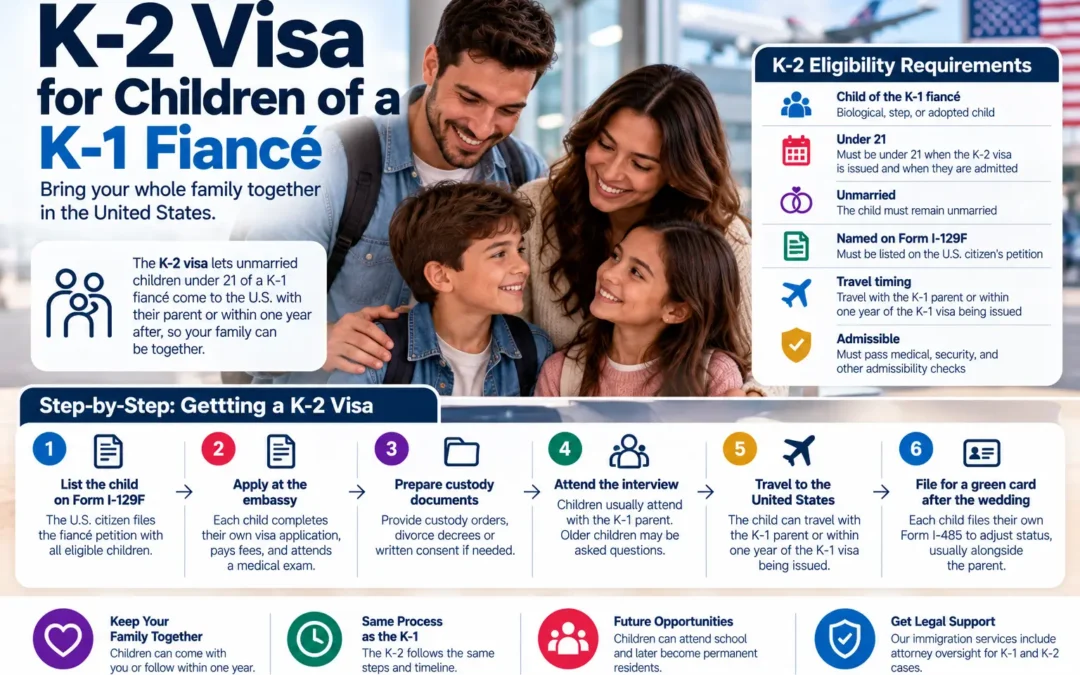
The K-2 visa lets unmarried children under 21 of a K-1 fiancé come to the United States with their parent or within one year after. The children must be listed on the U.S. citizen’s Form I-129F, but they need no separate petition. After the wedding, each child files their own green card application.
When you fall in love with someone who has children, you are not just planning a wedding. You are planning a family. For many couples, the biggest fear about the fiancé visa process is the idea of leaving a child behind. The K-2 visa exists so that does not have to happen. Here is how it works, and where families most often run into trouble.
What Is the K-2 Visa?
The K-2 is a derivative visa. It depends entirely on the parent’s K-1 fiancé visa. When a U.S. citizen petitions for a foreign fiancé, the fiancé’s eligible children can receive K-2 visas and enter the U.S. too. You can read the official overview on the State Department K-1 and K-2 visa page.
If you are new to the fiancé visa process, start with our guide to K-1 fiancé visa requirements and timeline. The K-2 follows the same path, step for step.
Who Qualifies for a K-2 Visa?
| Requirement | What It Means |
|---|---|
| Child of the K-1 fiancé | Biological, step, or adopted child of the foreign fiancé, under U.S. immigration rules |
| Under 21 | The child must be under 21 when the K-2 visa is issued and when they are admitted |
| Unmarried | The child must remain unmarried |
| Named on Form I-129F | The U.S. citizen must list the child on the fiancé petition |
| Travel timing | The child travels with the K-1 parent or within one year of the K-1 visa being issued |
| Admissible | The child passes medical, security, and other admissibility checks |
The U.S. citizen does not need to be the child’s parent. The child’s eligibility comes from the foreign fiancé.
Step-by-Step: Getting a K-2 Visa
Step 1: List the Child on Form I-129F
The U.S. citizen files Form I-129F, Petition for Alien Fiancé(e), with USCIS. Every child of the fiancé must be listed, even children who plan to stay behind for now. A child left off the petition may lose the K-2 option entirely, so list everyone.
Step 2: Apply at the Embassy
Once USCIS approves the petition and sends it to the embassy, each child completes their own online visa application and pays their own visa fee. Children need their own passport, birth certificate, police certificates if old enough, and a medical exam with an approved panel physician.
Step 3: Prepare Custody Documents
If the child’s other parent is still living, embassies often ask for proof that the child can legally leave the country. This might be a custody order, a divorce decree granting custody, or written consent from the other parent. Our guide on remarrying after divorce explains why divorce paperwork matters in more than one way.
Step 4: Attend the Interview
Children usually attend the interview with the K-1 parent. Older children may be asked simple questions about their family. Our K-1 interview preparation guide covers what to bring. K-2 applicants are also part of the newer K-1 social media screening, so older teens should list their accounts honestly.
Step 5: Travel to the United States
The child can travel with the K-1 parent or follow later. The follow-to-join window is one year from the date the K-1 visa is issued. Miss it, and the K-2 option generally expires. The child would then need a separate immigrant petition, which can take much longer.
After Arrival: The 90-Day Wedding and the Green Card
The K-1 parent must marry the U.S. citizen petitioner within 90 days of entering. If that wedding does not happen, the K-2 children cannot stay either. Our guide to the K-1 90-day marriage deadline explains your options, and couples short on time can get married in 24 hours online.
After the wedding, each K-2 child files their own Form I-485 to adjust status, usually alongside the parent. No I-130 is needed, because the K visa itself is the basis for adjustment. Each child has a separate filing fee, so budget for it. Our guide to getting a green card after a K-1 marriage walks through the full adjustment process.
The Affidavit of Support Covers the Children
The U.S. citizen’s Form I-864 must show enough income for the whole household, including each child. Larger households need higher income. Check our guide to sponsor income requirements and make sure you use the new Form I-864 edition.
[CLIENT INPUT NEEDED: one real, anonymized observation from the Married Legally team, for example families who almost lost K-2 eligibility because a child was not listed on the I-129F.]
The Age-Out Problem: Children Close to 21
Age is where K-2 cases get tricky. The child must be under 21 when the K-2 visa is issued and when they enter the U.S. In Matter of Le, a 2011 precedent decision, the Board of Immigration Appeals held that a K-2 child is not ineligible to adjust status simply because they turned 21 after entering.
Even so, practitioners report that USCIS handling of older K-2 applicants can vary. The safest approach is to treat 21 as a hard deadline:
- File the I-129F as early as possible.
- Have the child travel with the K-1 parent, not later.
- Marry quickly after arrival.
- File the child’s I-485 immediately after the wedding.
If a child is 19 or older when you start, speak with an attorney before filing. Our post on whether you need an immigration attorney explains why cases like this benefit from legal help.
What If the Child Stays Behind for Now?
Some families decide that a child should finish a school year or stay with relatives before moving. That can work, but only inside the one-year follow-to-join window. If the child needs to wait longer, the U.S. citizen may later file an I-130 for them as a stepchild. That route generally requires the marriage to take place before the child turns 18, so timing matters. Talk through the options with an attorney before you leave anyone behind.
Common K-2 Mistakes to Avoid
- Leaving a child off the I-129F because they planned to stay behind.
- Missing the one-year follow-to-join window.
- Arriving without custody papers or consent from the other parent.
- Forgetting to count children in the household size on the I-864.
- Waiting too long to file the child’s I-485 after the wedding.
- Letting a child marry, which ends K-2 eligibility.
What This Means for You
Your fiancé’s children can come with them. List every child on the I-129F, gather custody documents early, travel within the one-year window, and file each child’s green card application promptly after the wedding. If any child is close to 21, move fast and get legal advice first.
Planning a family move, not just a fiancé visa? Our team handles K-1 visa qualification and the full fiancé visa application, including K-2 children, with attorney oversight. Book a free consultation today.
Frequently Asked Questions
Does a K-2 child need a separate petition?
No. A K-2 child does not need a separate I-129F or I-130. The child only needs to be listed on the U.S. citizen’s Form I-129F for the fiancé. The child does need their own visa application, fee, medical exam, and later their own Form I-485 to adjust status.
Can a K-2 child come to the U.S. later than the parent?
Yes. A K-2 child can follow the K-1 parent, but generally only within one year of the date the K-1 visa was issued. After that window closes, the child usually needs a new immigrant petition. Plan travel dates carefully and avoid waiting until the deadline is close.
What happens if my fiancé’s child turns 21?
The child must be under 21 when the K-2 visa is issued and at entry. A 2011 precedent, Matter of Le, supports adjustment even if the child turns 21 after entering, but USCIS practice can vary. If a child is approaching 21, file early and get legal advice.
Can K-2 children go to school in the U.S.?
Yes. Children in the U.S. on K-2 status can generally enroll in public school. Many families register children soon after arrival. Check with your local school district about the documents they require, such as proof of address, immunization records, and the child’s passport with the K-2 visa.
Do K-2 children need a medical exam?
Yes. Each K-2 applicant needs a medical exam with an embassy-approved panel physician before the interview, including age-appropriate vaccinations. Book early, since some panel physicians are busy. Keep the sealed results unopened if the clinic gives them to you, and bring them to the interview as instructed.
This article is general information about U.S. immigration procedure. It is not legal advice and it does not create an attorney client relationship. Immigration rules change often. For guidance on your own case, book a free consultation with the Married Legally team or speak with a licensed immigration attorney.