
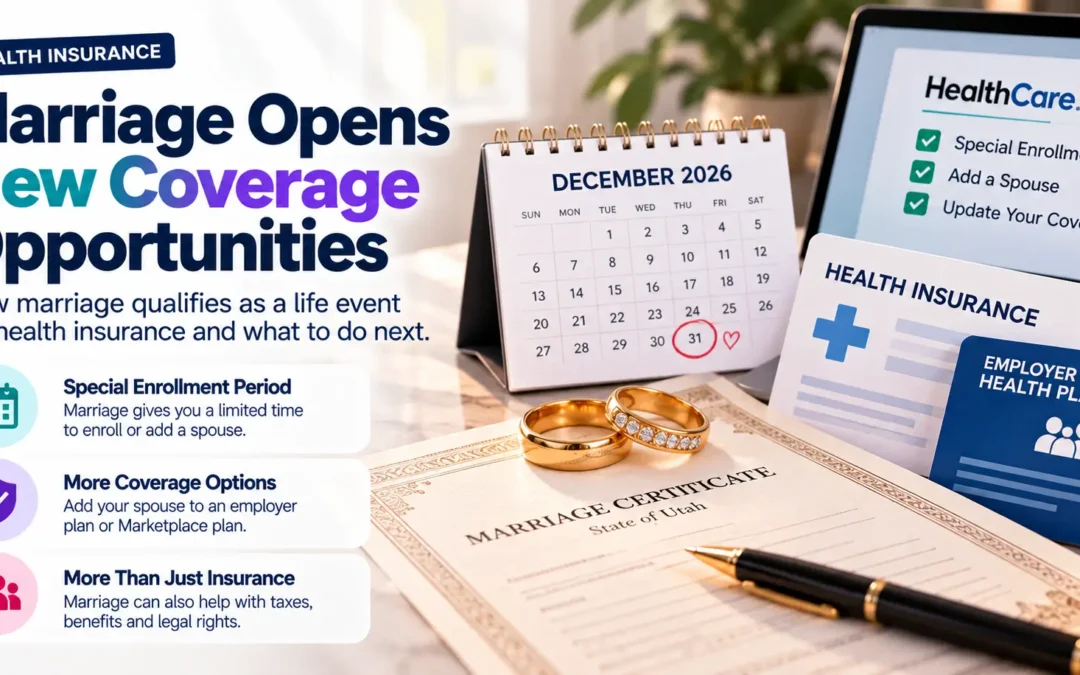
Marriage is a qualifying life event that opens a special enrollment period for health insurance. Employer plans generally must give you at least 30 days after the wedding to add your spouse, and HealthCare.gov typically gives 60 days. Miss the window, and you may wait until the next open enrollment.
For many couples, health insurance is one of the most practical reasons to marry sooner rather than later. One partner has great coverage through work. The other is uninsured, paying high premiums, or about to lose a plan. Marriage can fix that, but only if you act within a short window. Here is how the rules work and how to time your wedding so nobody goes without coverage.
What Is a Qualifying Life Event?
Most people can only sign up for or change health insurance during an annual open enrollment period. A qualifying life event is a major change, such as marriage, a birth, or losing other coverage, that opens a special enrollment period outside that window.
Marriage is one of the most common qualifying events. HealthCare.gov lists it on its special enrollment period page, and federal law requires most employer group health plans to allow special enrollment after marriage too.
Employer Plans vs Marketplace Plans
| Coverage Type | Typical Window After Marriage | When Coverage Usually Starts |
|---|---|---|
| Employer group health plan | At least 30 days | No later than the first of the month after you request enrollment |
| HealthCare.gov Marketplace | 60 days | First of the month after you pick a plan |
| State-run marketplace | Usually 60 days, check your state | Set by your state marketplace |
| TRICARE (military) | Register your spouse in DEERS first | Set by TRICARE rules |
Employer Plans
Under federal special enrollment rules, explained by the U.S. Department of Labor, most group health plans must let you add a new spouse if you request it within 30 days of the marriage. Some employers give longer. Your plan document or HR team will confirm the exact deadline and what proof they need.
Marketplace Plans
If you buy coverage through HealthCare.gov, you generally have 60 days after the wedding to enroll or change plans. HealthCare.gov’s getting married guide explains an important condition: usually at least one spouse must have had qualifying coverage for at least one day in the 60 days before the marriage, unless an exception applies, such as having lived abroad.
Open Enrollment vs Special Enrollment
Open enrollment for 2027 Marketplace coverage begins on November 1, 2026. In HealthCare.gov states, enrolling by December 15 typically gets you coverage starting January 1. End dates vary by state, so check your marketplace for the final deadline.
If you plan to marry in November or December, you have a choice. You can enroll during open enrollment as you are, then update your application after the wedding. Or you can marry first and use the marriage special enrollment period. Either way, report the marriage to the Marketplace, because household size and income affect any premium tax credit.
[CLIENT INPUT NEEDED: one real, anonymized observation from the Married Legally team, for example how often couples marry quickly to get a partner onto health coverage.]
Proof You Will Need
Insurers and employers usually ask for proof of the marriage. In most cases that means a copy of your marriage certificate, not your marriage license. Our guide to marriage license vs marriage certificate explains the difference.
Some employers also ask for proof of address or a recent joint document for dependent verification. Request your certificate promptly after the ceremony, so you are ready before the deadline. A legally valid online marriage produces an official certificate that is recognized nationwide, as our state recognition guide explains.
Which Plan Should Cover You Both?
Once you are married, you may have several choices. You could both join one employer plan, keep separate plans, or move to a Marketplace plan together. The cheapest premium is not always the best value. Compare deductibles, out-of-pocket maximums, and which doctors are in network for both of you.
Watch for spousal surcharges. Some employers charge extra to cover a spouse who could get coverage through their own job, or exclude that spouse entirely. If both of you have employer coverage available, ask each HR team for the full cost of covering the other spouse and any children before you choose.
Also think about the year ahead. If a baby, a move, or a job change is likely, choose the plan that handles that change best. A call with a licensed insurance broker can help you compare options.
Common Mistakes That Leave a Spouse Uninsured
- Waiting too long after the wedding to tell HR or the Marketplace.
- Assuming living together counts. It does not, as our post on common law marriage myths explains.
- Not having the marriage certificate ready when the plan asks for it.
- Forgetting to update income and household size, leading to a tax credit surprise.
- Assuming the employer covers spouses. Some plans exclude spouses with access to their own employer coverage.
- Dropping one plan before the new coverage starts.
Special Situations
Military Couples
Service members must register a new spouse in DEERS before the spouse can use TRICARE. Couples facing deployment or a move often need to marry fast, which is why many use our military online wedding service.
Spouses New to the United States
If your spouse recently immigrated, Marketplace eligibility depends on immigration status. HealthCare.gov’s page on coverage for immigrants explains which statuses qualify. Questions about how coverage interacts with an immigration case are best handled by professionals, so see our marriage and immigration team.
Tax Timing
Marriage also changes your tax filing status for the whole year if you marry by December 31. Our post on getting married before the end of the year explains how that interacts with premium tax credits.
How to Marry in Time
When insurance is the reason, timing matters more than the venue. Traditional weddings take months to plan, and courthouse appointments can be hard to find around the holidays. A legal online ceremony under a Utah license can be arranged quickly from home. See how couples get married in 24 hours, or read our guide on how to get married fast.
Your Insurance Checklist After the Wedding
- Write down your wedding date and count 30 and 60 days forward.
- Order certified copies of your marriage certificate.
- Contact HR or your marketplace within the first week.
- Submit proof of marriage and any other requested documents.
- Confirm the coverage start date in writing.
- Keep the old plan until the new one starts.
- Update income and household size for any premium tax credit.
What This Means for You
Marriage lets you add a spouse to health insurance outside open enrollment, but the window is short: often 30 days for employer plans and 60 days for the Marketplace. Have your marriage certificate ready, contact your plan quickly, and keep existing coverage until the new plan begins.
Need to be married before a coverage deadline? Browse our online wedding packages, or contact our team to ask about the fastest available ceremony date.
Frequently Asked Questions
Is marriage a qualifying life event for health insurance?
Yes. Marriage is a qualifying life event that opens a special enrollment period. It lets you add a new spouse to an employer plan or enroll in or change a Marketplace plan outside open enrollment. Each type of plan sets its own deadline, so act quickly after the wedding.
How long do I have to add my spouse after marriage?
Employer group health plans generally must allow at least 30 days after the marriage, though some give longer. HealthCare.gov typically allows 60 days. Check your plan documents or your marketplace for the exact deadline, and do not wait until the last week to submit your request.
Can I get married just to get health insurance?
A legally valid marriage qualifies regardless of your reasons, and many couples time their wedding around coverage needs. Marriage also affects taxes, benefits, inheritance, and legal decisions, so it should be a decision you would make anyway. Insurance can simply help you choose when.
Does an online marriage count for health insurance?
Yes, if it is legally valid. A properly performed online marriage under a Utah license produces an official marriage certificate, which employers and insurers accept as proof of marriage. Order certified copies quickly so you can submit them before your enrollment deadline closes.
What if we miss the special enrollment deadline?
You will usually have to wait for the next open enrollment period, unless another qualifying event happens. Some employers allow exceptions, but most do not. That is why it helps to plan the wedding date with the enrollment window in mind and contact your plan right away.
This article is general information. It is not insurance, tax, or legal advice, and it does not create an attorney client relationship. Plan rules and deadlines vary. Check with your employer, insurer, or marketplace about your own coverage, or contact the Married Legally team with questions about getting married.