
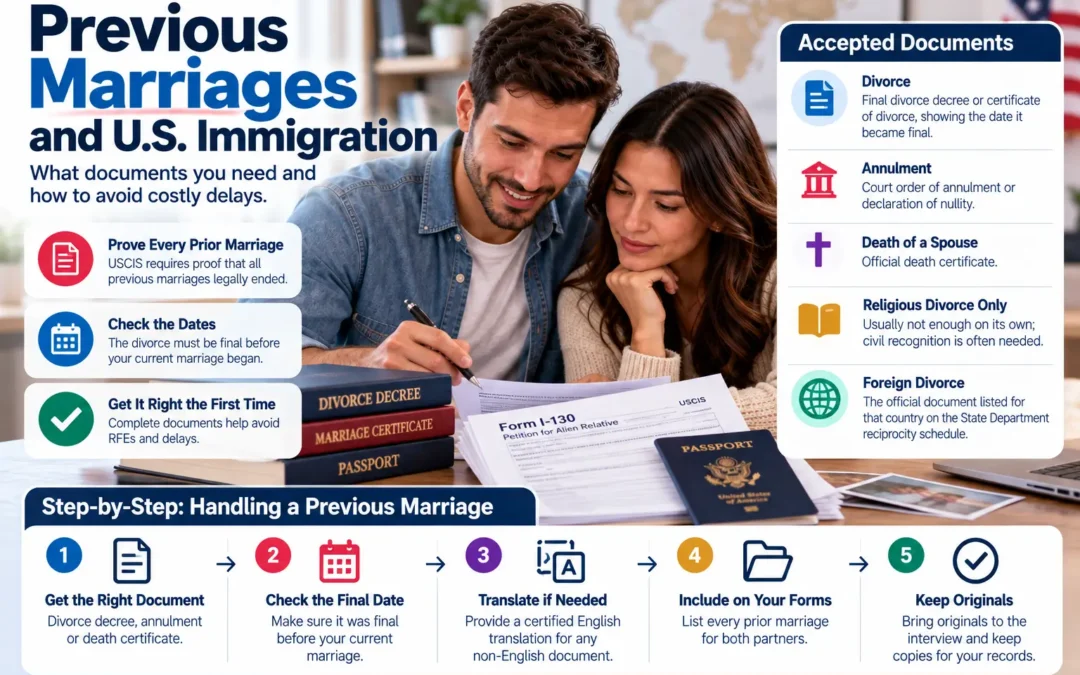
USCIS requires proof that every prior marriage legally ended before a new marriage began.
Second marriages are common, and there is nothing unusual about one in an immigration case. But a past marriage that was never properly closed out is one of the quietest ways a petition goes wrong. It does not matter how real your new relationship is. If the law says one of you was still married, the new marriage may not count. Here is how to make sure that never happens to you.
The CR-1 visa processing time in 2026 is commonly reported at roughly 14 to 24 months from filing Form I-130 to visa issuance. The biggest share is USCIS review of the I-130, followed by National Visa Center document processing and the wait for an embassy interview, which varies widely by country.
When you are married and living in different countries, every month apart feels long. The hardest part is often not knowing where you are in the process or what comes next. This guide breaks the CR-1 timeline into stages, so you can see what is normal, what you can speed up, and where to check the official numbers yourself.
Why USCIS Cares About Your Previous Marriage
An immigration petition based on marriage depends on a legally valid marriage. If either spouse was still legally married to someone else on the wedding day, the new marriage is generally void. USCIS cannot approve a petition based on a marriage that does not legally exist.
That is why the official Form I-130 instructions ask for evidence that all prior marriages of both spouses were legally terminated. The same applies to fiancé petitions, where both partners must be legally free to marry. Our guide to K-1 fiancé visa requirements covers that rule for engaged couples.
Documents That Prove a Marriage Ended
| How the Marriage Ended | Document USCIS Expects |
|---|---|
| Divorce | Final divorce decree or certificate of divorce, showing the date it became final |
| Annulment | Court order of annulment or declaration of nullity |
| Death of a spouse | Official death certificate |
| Religious divorce only | Usually not enough on its own; civil recognition is often needed |
| Foreign divorce | The official document listed for that country on the State Department reciprocity schedule |
Use the Final Decree, Not the Filing
A petition for divorce, a separation agreement, or an interim order is not enough. USCIS needs the final document showing the marriage legally ended. Many courts issue a short certificate of divorce alongside the full decree. Either can work if it clearly shows the names, the court, and the date the divorce became final.
Name Changes
Divorce often comes with a name change. If your divorce decree restores a former name, make sure the name on your passport, your forms, and your new marriage certificate all connect clearly. USCIS reads these documents together. A short explanation of each name change in your cover letter helps the officer easily follow your history and avoids unnecessary questions later.
Foreign Documents
Each country issues divorce records differently. The State Department’s visa reciprocity and civil documents page lists which document is acceptable from each country, and who issues it. Check it before you order anything.
Every document not in English needs a full English translation with a translator’s certification of competence and accuracy, as required by 8 CFR 103.2(b)(3).
The Timing Trap: When Did the Divorce Become Final?
This is the mistake we see most. The divorce must be final before the new wedding, not just filed. Some courts set a waiting period between the judgment and the date it becomes final. Some states also restrict remarriage for a short period after a divorce.
If you married even one day before the divorce became final, the new marriage may be invalid. The fix is usually to marry again, now that both of you are free to do so, and file based on the new marriage. That can feel awkward, but it is far better than a denial. Our guide to getting remarried after divorce explains the wedding paperwork side of this.
[CLIENT INPUT NEEDED: one real, anonymized observation from the Married Legally team, for example couples who discovered a divorce was not final until after their wedding.]
Countries Where Divorce Is Difficult
Some countries make ending a marriage slow or complicated. In the Philippines, for example, divorce is not generally available to most citizens. Many Filipino fiancés need a court declaration of nullity or annulment, or judicial recognition of a foreign divorce, before they are free to marry again. These cases can take a long time, so start early.
If your partner is from the Philippines, our page on Philippines to USA immigration covers the local steps couples need to plan for. Couples from other countries with religious or customary divorces should confirm that the divorce is recognized under civil law before relying on it.
Special Rule for Green Card Holders Who Married Before
There is an extra hurdle for some permanent residents. If you got your own green card through a previous marriage, and you now want to sponsor a new spouse within five years of becoming a resident, INA 204(a)(2) generally requires you to prove, by clear and convincing evidence, that your first marriage was genuine. Exceptions apply, such as when the first marriage ended through the death of the spouse.
This rule surprises many petitioners. If it might apply to you, read our post on marrying a green card holder vs a U.S. citizen and get legal advice before filing.
Children From a Previous Marriage
If a fiancé or spouse has children from an earlier relationship, the divorce decree often matters twice. It proves the old marriage ended, and it may show who has custody. Embassies often ask for custody orders or the other parent’s consent before a child can travel. Our K-2 visa guide covers this in detail.
How to Get a Lost Divorce Decree
- Contact the court clerk in the county or district where the divorce was granted.
- Ask for a certified copy of the final decree or a certificate of divorce.
- Have the case number, full names, and approximate date ready.
- For a foreign divorce, check the reciprocity schedule for the correct issuing office.
- Order translations for any non-English document.
- Keep the originals safe for the interview.
Prior Marriage Checklist
- List every prior marriage for both partners on the forms, with exact dates.
- Submit proof that each one legally ended.
- Confirm each divorce was final before your current wedding.
- Use certified translations for foreign documents.
- Check for the five-year rule if the petitioner is a green card holder who married before.
- Keep originals ready for any interview.
Missing or inconsistent marriage history is one of the paperwork issues behind many visa denials, and it is easy to prevent. For the full spousal filing, see our guide on how to file an I-130 for your spouse.
What This Means for You
A previous marriage does not hurt your case. An undocumented one does. Get the final decree or death certificate for every prior marriage, confirm the dates, and translate anything foreign. If a divorce was not final before your wedding, fix it by remarrying before you file.
Free to marry and ready to start? A legal online marriage for immigration gives you a valid marriage certificate, wherever you each live. Unsure whether your documents are enough? Our immigration services include attorney review. Book a free consultation today.
Frequently Asked Questions
Do I need my divorce decree for an I-130?
Yes. If you or your spouse were married before, USCIS requires proof that every prior marriage legally ended. For a divorce, that means a copy of the final divorce decree or certificate of divorce. Without it, USCIS may issue a Request for Evidence or deny the petition.
What if my divorce was not final when I remarried?
Your current marriage may not be legally valid, which means it generally cannot support an immigration petition. The usual fix is to marry again now that you are both free to marry, and then file based on the new marriage. Speak with an attorney before filing if you are unsure.
Does USCIS accept religious divorces?
A religious divorce alone is often not enough. USCIS generally looks for a divorce that is legally recognized by the civil authorities in the country where it took place. Check the State Department reciprocity schedule for that country, and get legal advice if the divorce was only religious or customary.
Does my fiancé need to prove their prior marriage ended?
Yes. For a K-1 fiancé visa, both partners must be legally free to marry when the petition is filed. That means proof that every prior marriage of both the U.S. citizen and the foreign fiancé has legally ended, usually through a final divorce decree, annulment, or death certificate.
What if I cannot find my old divorce decree?
Contact the court clerk where the divorce was granted and request a certified copy. You will usually need the case number, full names, and approximate date. For a foreign divorce, check the State Department reciprocity schedule to see which office issues the official record in that country.
This article is general information about U.S. immigration procedure. It is not legal advice and it does not create an attorney client relationship. Immigration rules change often. For guidance on your own case, book a free consultation with the Married Legally team or speak with a licensed immigration attorney.